What to write… what to write…!
Well, it may be a good idea to update on how I am doing and what I am doing since a few folks have been asking.
I am happy to report that overall I am doing well (except for this very moment where I am suffering from allergies). I feel a lot more settled here and actually starting to like my life in Santa Cruz. I honestly think that Josh´s and my family´s visit helped a lot. They are the ones I talk with the most on a regular basis and they can understand better my context which helps them support me!
Coming as a SALTer has had its challenges. SALTers in Bolivia kind of get lost within the MCC team and we don’t receive too much support/affirmation (except for a great coordinators) from MCC Bolivia. That was really hard in the beginning but I think a lot of us have adjusted appropriately. I came in with the notion that the SALT program (Serving and Living Together) would be more intentional on processing with SALTers and even though that has not been the case, I have had the opportunities to do that with my boss, coworkers, family, and friends. Naturally, they most often don’t understand where I am coming from but I love learning their points of view and the context in where those views developed.
We are anxiously waiting for the new daycare to be finished. It is still under construction and has been delayed due to the rainy season! I am honestly nervous that it is not going to be completed by the date we told the families we would be open- March 1st. And we are short a few thousand dollars to pay it off. Those two things have definitely added tension to the work environment but we have still kept positive attitudes which a lot of that can be attributed to rejuvenated spirits.
I have grown closer to my host family over the last couple of months which has been really fun. They are so different than any other host family, mainly because of family structure, history, and theological beliefs. I really enjoy going to mass every Saturday night. Such a different but beautiful style of worship. I am not permitted to take communion because I hasvent taken my First Communion within the Catholic church BUT I do get to go up at the end of every service and get blessed by the father by sprinkling water on me using a white rose. That is usually the highlight of the service for me because I actually get to participate.
Soon I will start visiting families and I am pumped but also nervous. There are many cultural offenses that I am just learning that I wasn’t aware of like…do not toss anything to people, do not sit with your back facing a person (even if they are not part of the conversation/meeting/group), do not mentioned that you are going shopping to buy used clothing, and always always look good! Ahh! The last cultural value listed has forced me to go to markets to buy new clothing because I really don’t have any clothes that are nice.
In all it has been fun finally adjusting to the city, culture, and life. I still have my homesickness moments but they are fading away more and more as I start to realize what little time I have left and all the many things I have yet to discover and people to meet.
Que Dios les bendiga!
Friday, February 19, 2010

Saturday, February 13, 2010
half ass entry
Excuse my language! But nothing can describe this entry as good as that. I want to post about various things with pictures but I don´t have my camera or time right now. Here are some links for those who want to read more about the political/social situation in Bolivia. Enjoy!
http://ain-bolivia.org/2010/01/debunking-myths-the-eastern-lowlands-of-santa-cruz-part-of-an-integrated-bolivia/
http://ain-bolivia.org/2010/02/debunking-myths-part-ii-bolivia%E2%80%99s-autonomy-initiatives/
Happy Valentine´s Day Josh! and Happy Carnaval!
http://ain-bolivia.org/2010/01/debunking-myths-the-eastern-lowlands-of-santa-cruz-part-of-an-integrated-bolivia/
http://ain-bolivia.org/2010/02/debunking-myths-part-ii-bolivia%E2%80%99s-autonomy-initiatives/
Happy Valentine´s Day Josh! and Happy Carnaval!
Tuesday, February 2, 2010
El Choque
¨Choque¨ in spanish means a impact, crash, shock, or clash. I usually use the word to mean cultural clash. Growing up in a Latin American home (within the US context), having visited Puerto Rico many times, and having lived in Ecuador, I thought coming to Bolivia would be cake. Naturally, I expected some misunderstandings or situations where I would feel out of context but never did I expect it to be at this level. I feel like I am constanting clashing with the culture. Perhaps I have never felt this before because I have never worked or lived for more than five months in those other contexts. For the exception of my home where I grew up which had acculturated a significant amount to our broader society.
Here in Bolivia, I am confronted daily with things I dont understand or like or even want to learn to like or deal with. These include (in Santa Cruz)- machisimo, spanish words specific to Bolivia (there are A LOT), the food, the coya/camba conflict, trash, pedestrians not having the right away, hatred against Evo, poor nutrition habits, urinating in public, people pushing to get a seat on the bus, abandoned women and children, people be robbed at gunpoint, drunk men hitting/falling on me. I have hit rock bottom of the cultural clash chart. I hate admitting that too. I have grown up in a society where my culture often is unacknowledged and oppressed. So of course, I thought before coming here... ¨no way will I judge cruceño culture!¨ I thought I could be very tolerant and not view the culture through North American lenses. I thought that I wouldn´t struggle with cultural clashes. I obviously wasn´t being honest with myself. And how can I then as a US citizen reconcile with that? That I hate sometimes this culture!
I acknowledge the fact that I my country (yes, I am calling the US my country!) has played a major role in many of those aspects that I just listed. The trash, nutrition habits, political climate, alcoholism, etc. It is a hard reality to face.
I have to constantly remind myself that I am privileged to be here and that I am human. I am imperfect. Even if I came with the notion to Bolivia that I wouldn´t struggle with cultural differences, that I would be the best SALTer MCC or Samuelito has ever seen, the greatest host sister, daughter, grandaughter, niece to my Bolivian family, sooner or later I would have to realize that I was being very unrealistic. But in the midst of learning how to cope, how to reconcile, how to appreciate, how to build relationships with the marginalized, the poor, and even the rich of Santa Cruz, I am maturing as an individual. And something that Bolivians have taught me here in Santa Cruz is to see the beauty that is all around me. This beauty includes the determined loving spirit of the families I work with, the fruit trees that populate the city, the children that walk along the roads, the vendors that sell me soda in a bag, the clear sunsets, the business of the rotonda, and many many more. It is always good to remind myself in the midst of the ¨choque¨ to look for that beauty because in my business and at times, grumpiness, I can easily miss it. Beauty is not always loud in our faces but is hidden all around us. We just need open eyes and hearts to see it. Then, once we can embrace our individual darkness (frustrations, fears, etc.), seek and appreciate the beauty, and are open to learn, we can be agents of change for the communities we work with and love. I believe it is truly a life long process.
Monday, January 25, 2010
I really like pictures
Alright, so, I realize that I have been using a lot of pictures in my latest entries...and all I want to say is, it is not because I don't want to write a REAL entry. Its that I love pictures so I figure so does everyone else! Some are old pictures but honestly, I don't have anything interesting to blog about except for maybe complaints...but that is not interesting and I don't want to self indulge in self pity about stupid things like mosquitoes :P So here is my last month of work of 2009 in pictures and some family too :) This is a picture of my 10 year old host sister, Nati (short for Natalia) holding my six month old host niece, Genesis. Yes, Genesis is bundled up even though it was probably about 80 degress when this picture was taken (okay, maybe 75). But that is how the Bolivians do. Kids get sick from being cold. Anyway, I love how fat and adorable Genesis is.
 This child doesn't actually attend the guaderia but is actually a relative of one of our kids. So precious I couldnt resist!
 This is the latest picture I have of the new building that is being constructed. I am excited to say that since I took this picture the roof is complete and the floors are installed, whoo hoo!
 Boys will be boys.
 Dancing! We had a end of the year birthday party for all of the kids in December. It was so fun! Here are two girls dancing merengue. They learn young...that is why they are so amazing at dancing.
 The cake. Yumm. And the "canasta" which are gift/candy bags the teachers made for the kids.
 My friend Daniel and I. He is engaged to a SALTER who came a few years ago. He is always helping around the daycare. It was a hot day...can you tell? :)
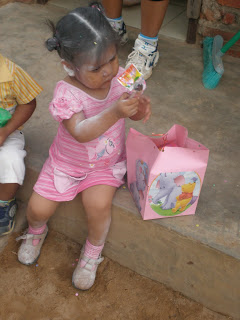 We had pinata for every classroom. The baby pinata was full of candy, toys, and baby powder! At first Haylen cried because she was shocked when all the powder exploded all over her but she quickly got over it once she realized we were all laughing and helping her grab candy.
 Smile! Everything is all good.
 This is a picture of my 10 year old host sister, Nati (short for Natalia) holding my six month old host niece, Genesis. Yes, Genesis is bundled up even though it was probably about 80 degress when this picture was taken (okay, maybe 75). But that is how the Bolivians do. Kids get sick from being cold. Anyway, I love how fat and adorable Genesis is.
 This child doesn't actually attend the guaderia but is actually a relative of one of our kids. So precious I couldnt resist!
 This is the latest picture I have of the new building that is being constructed. I am excited to say that since I took this picture the roof is complete and the floors are installed, whoo hoo!
 Boys will be boys.
 Dancing! We had a end of the year birthday party for all of the kids in December. It was so fun! Here are two girls dancing merengue. They learn young...that is why they are so amazing at dancing.
 The cake. Yumm. And the "canasta" which are gift/candy bags the teachers made for the kids.
 My friend Daniel and I. He is engaged to a SALTER who came a few years ago. He is always helping around the daycare. It was a hot day...can you tell? :)
 We had pinata for every classroom. The baby pinata was full of candy, toys, and baby powder! At first Haylen cried because she was shocked when all the powder exploded all over her but she quickly got over it once she realized we were all laughing and helping her grab candy.
 Smile! Everything is all good.
Tuesday, January 19, 2010
Thank You, Na
This blog is dedicated to posting amazing, beautiful pictures that my good friend, Nadia, found. I also want to post these pictures not just because they are so vibrant but because they are really good shots of what the other half of the country is like. A history, peoples and cultures that I have always been drawn and intrigued by but unfortunately, am not working with or interacting with in Santa Cruz.
Note: I did not take these pictures (I don't have that kind of picture taking talent) and much of the information is a summary of their captions (and maybe some of my own input).
Website: http://www.boston.com/bigpicture/2009/02/bolivia_and_its_new_constituti.html
You can visit this website above to read the descriptions in more detail and to look at more gorgeous pictures.
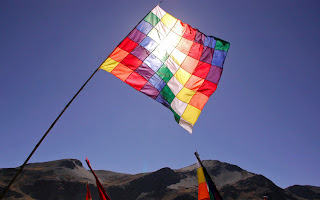 Indigenous Flag. One can see this waving around all over in La Paz. But I have yet to see one hung up in Santa Cruz.
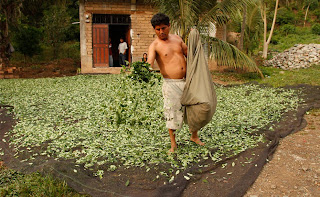 This man is a coca farmer. He is spreading leaves out to be dried by the sun. During the Bush administration, the US Drug Enforcement Administration requested to fly anti-narcotic missions over Bolivia. Evo Morales, Bolivia's president, rejected the request and as a result, the US suspended trade preferences (http://www.boston.com/bigpicture/2009/02/bolivia_and_its_new_constituti.html). If you are interested in learning more about the conflict invovled with this plant, email me because I can send you a paper I wrote for Plants and Peoples about it.
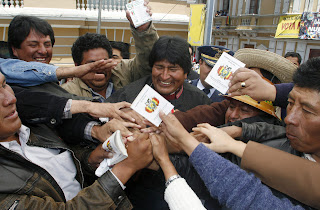 The man in the middle handing out copies of the Bolivia's new constitution (2008) is the president of Bolivia, Evo Morales. He just got re-elected for his second term as president this past December. I had the privilege of going to a rally/demonstration of his when he visited Plan 3000 during his campaign and saw him in person.
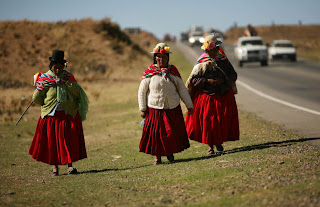 Indigenous woman walking along the highway. They wear very vibrant colors which is a regular part of their dress.
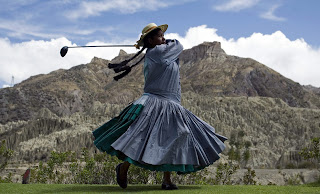 Not much to say but loving this picture of this Aymara indigenous woman.
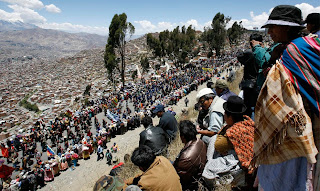 These are inhabits from El Alto watching people march in La Paz. El Alto is a city that sits right above La Paz. The majority of the population of El Alto are Aymara.
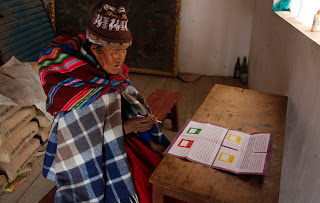 This Aymara woman is voting in a school located in the campo.
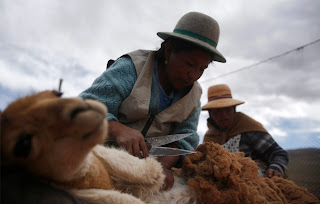 Women shearing a vicuña in an Andean village.
 Supporter of Evo Morales marching toward La Paz.
Note: I did not take these pictures (I don't have that kind of picture taking talent) and much of the information is a summary of their captions (and maybe some of my own input).
Website: http://www.boston.com/bigpicture/2009/02/bolivia_and_its_new_constituti.html
You can visit this website above to read the descriptions in more detail and to look at more gorgeous pictures.
 Indigenous Flag. One can see this waving around all over in La Paz. But I have yet to see one hung up in Santa Cruz.
 This man is a coca farmer. He is spreading leaves out to be dried by the sun. During the Bush administration, the US Drug Enforcement Administration requested to fly anti-narcotic missions over Bolivia. Evo Morales, Bolivia's president, rejected the request and as a result, the US suspended trade preferences (http://www.boston.com/bigpicture/2009/02/bolivia_and_its_new_constituti.html). If you are interested in learning more about the conflict invovled with this plant, email me because I can send you a paper I wrote for Plants and Peoples about it.
 The man in the middle handing out copies of the Bolivia's new constitution (2008) is the president of Bolivia, Evo Morales. He just got re-elected for his second term as president this past December. I had the privilege of going to a rally/demonstration of his when he visited Plan 3000 during his campaign and saw him in person.
 Indigenous woman walking along the highway. They wear very vibrant colors which is a regular part of their dress.
 Not much to say but loving this picture of this Aymara indigenous woman.
 These are inhabits from El Alto watching people march in La Paz. El Alto is a city that sits right above La Paz. The majority of the population of El Alto are Aymara.
 This Aymara woman is voting in a school located in the campo.
 Women shearing a vicuña in an Andean village.
 Supporter of Evo Morales marching toward La Paz.
Friday, January 15, 2010
Quest to get back to S. Cruz!
In most people’s life, one often desires an adventure. We four friends, who traveled to La Paz for a three-day stay, thought we were sadly ending our journey one Wednesday night when scheduled to travel back to Santa Cruz. Little did we know that we were embarking on another adventure, an unforeseen quest to get home.
We spent our last day in La Paz doing last minute shopping and picture taking. At 4pm we finally stop to eat a restaurant before we leave on our 530pm bus. Food came at 5pm (45 minutes late) and we were running out of there by 5:07pm feeling a little sick. After catching a taxi going the wrong direction, getting stuck in traffic, losing one of our bags full of gifts, a bible, books, and pictures, shedding some tears and chasing our bus down in El Alto, we finally boarded our bus. We all breathed a sigh of relief and sit in our bus ready to start the journey back to Santa Cruz. Little did we know that was just the beginning of our adventure.
At about 1:30am that night, one of the drivers comes upstairs to the second floor of the bus, and announces in a meek voice that there had been mudslides and that we are not permitted to pass. Ignoring one passenger’s question of “what are we going to do?,” he retreats back to the cockpit and turns off the bus. We sit there until we are awoken the next morning by vendors outside selling breakfast, beans and fried fish, to the passengers of our bus and all of the other passengers of competing bus lines. Realizing we had not moved at all during the night, we ask one of our seat neighbors what is our current location. She replies that she is unsure but that we are just outside of Cochabamba about ten hours away from Santa Cruz. Sigh. After accepting the fact that we were not going to get into Santa Cruz by 9am as originally planned, we get off the bus to stretch, take a potty break in a nearby field, and buy some food and water. Other activities that morning included running away from a moving tractor trailer, jumping on a moving bus, screaming ”this is a conspiracy!”,and standing by watching other passengers exchanged not so friendly words with the drivers.
Finally, at 9:30am, we are allowed to pass through. We stopped for lunch at a pensión and at another time for a drug search. A few hours later when we saw a sign that read, “30 km Santa Cruz”, we all thought at that point that nothing could go wrong. Then the dreadful bus stop and once again one of the drivers came upstairs and announced once again in his meek voice that there is a political blockade and that we are stuck in a jam. So there we were once again…stuck. At this point, we decided to be proactive and after an hour of waiting, we got off the bus with all of our baggage and joined the throngs walking to find taxis on the other side of the blockade. We made friends along the 45-minute walk. We saw that we had made a good decision after seeing the hundreds of cars, trucks, micros that were stuck, some since 3pm. We make it back to CCM at around 730pm. After 26 hours of traveling, the lesson learned was it is wise to fly during rainy season and that patience truly is a virtue.
Saturday, January 9, 2010
A Theology of Liberation
As I have worked and experienced life here in Latin America, I have come across many different worldviews and theologies. Many are very different from mine but I have learned that no one truly has the right answer. The only answers. In the end...theologies are created to help us interpret our context and that will often influence how we receive and understand Scripture.
Theology-defined by dictionary.com
Interesting. These two definitions doesnt mean much to me. I also at times hate theology. Because although it is helpful because it is human interpretation of Scripture, it can also cause divisions among the body of Christ.
I always find it interesting when people believe they have the perfect or the RIGHT theology. Isnt is human interpretation? Arent we imperfect beings? So how can our theology be completely right or flawless? That is not to say there isnt any bad theology out here. And I do believe there are things that are not up for debate within the Christian religion.
1. Jesus death liberates us from sin
2. Jesus-Son of God, Son of man
3. God loves us unconditionally and we live in grace
But things such as drinking, dancing, hell, baptism, etc etc etc, I personally don't think we have to have the exact right answers. But then again...perhaps that is my theology :)
I have been reading about liberation theology lately since it is a theology quite popular in Latin America (although not one I encounter on a daily basis here in Santa Cruz). Gustavo Gutierrez is considered the father of liberation theology. He is a native of Peru and he lives and works in Rimac a Lima slum.
There was something I read that struck me and I think is good food for thought. The following is found in a section called, Christ the Liberator.
He writes, "But in the liberation approach sin is not considered as an individual, private, or merely interior reality--asserted just enough to necessitate "spiritual" redemption which does not challenge the order in which we live. Sin is regarded as a social, historical fact, the absence of fellowship and love in relationships among persons, the breach of friendship with God and with other persons, and, therefore, an interior, personal fracture. When it is considered in this way, the collective dimensions of sin are rediscovered" (Gutierrez, p. 103).
He continues with...
"This radical liberation is the gift which Christ offers us. By his death and resurrection he redeems us from sin and all its consequences, as has been well said in a text we quote again: 'It is the same God who, in the fullness of time, sends his Son in the flesh, so that he might come to liberate all men from all slavery to which sin has subjected them: hunger, misery, oppression, and ignorance, in a word, that injustice and hatred which have their own origin in human selfishness.' This is why the Christian life is a passover, a transition from sin to grace, from death to life, from injustice to justice, from the subhuman to the human. Christ introduces us by the gift of his Spirit into communion with God and with all human beings. More precisely, it is because he introduces us into this communion, into a continuous search for its fullness, that he conquers sin--which is the negation of love--and all its consequences" (Gutierrez, p. 103).
Pretty incredible. Thoughts?
Theology-defined by dictionary.com
| 1. | the field of study and analysis that treats of God and of God's attributes and relations to the universe; study of divine things or religious truth; divinity. |
| 2. | a particular form, system, branch, or course of this study |
Interesting. These two definitions doesnt mean much to me. I also at times hate theology. Because although it is helpful because it is human interpretation of Scripture, it can also cause divisions among the body of Christ.
I always find it interesting when people believe they have the perfect or the RIGHT theology. Isnt is human interpretation? Arent we imperfect beings? So how can our theology be completely right or flawless? That is not to say there isnt any bad theology out here. And I do believe there are things that are not up for debate within the Christian religion.
1. Jesus death liberates us from sin
2. Jesus-Son of God, Son of man
3. God loves us unconditionally and we live in grace
But things such as drinking, dancing, hell, baptism, etc etc etc, I personally don't think we have to have the exact right answers. But then again...perhaps that is my theology :)
I have been reading about liberation theology lately since it is a theology quite popular in Latin America (although not one I encounter on a daily basis here in Santa Cruz). Gustavo Gutierrez is considered the father of liberation theology. He is a native of Peru and he lives and works in Rimac a Lima slum.
There was something I read that struck me and I think is good food for thought. The following is found in a section called, Christ the Liberator.
He writes, "But in the liberation approach sin is not considered as an individual, private, or merely interior reality--asserted just enough to necessitate "spiritual" redemption which does not challenge the order in which we live. Sin is regarded as a social, historical fact, the absence of fellowship and love in relationships among persons, the breach of friendship with God and with other persons, and, therefore, an interior, personal fracture. When it is considered in this way, the collective dimensions of sin are rediscovered" (Gutierrez, p. 103).
He continues with...
"This radical liberation is the gift which Christ offers us. By his death and resurrection he redeems us from sin and all its consequences, as has been well said in a text we quote again: 'It is the same God who, in the fullness of time, sends his Son in the flesh, so that he might come to liberate all men from all slavery to which sin has subjected them: hunger, misery, oppression, and ignorance, in a word, that injustice and hatred which have their own origin in human selfishness.' This is why the Christian life is a passover, a transition from sin to grace, from death to life, from injustice to justice, from the subhuman to the human. Christ introduces us by the gift of his Spirit into communion with God and with all human beings. More precisely, it is because he introduces us into this communion, into a continuous search for its fullness, that he conquers sin--which is the negation of love--and all its consequences" (Gutierrez, p. 103).
Pretty incredible. Thoughts?
Subscribe to:
Posts (Atom)
